Table of Contents
I booked a federal campground last autumn and paid the posted rate without a word. The man behind me, same age as me, paid half.
He had a pass in his wallet. I had the same right to one and had never bought it.
Most guides on campground fees are written for families in tents. This one is written for us, and for the rigs we tow.
The Short Answer on Campground Fees for Seniors
Two systems control your campground fees. Federal sites run on the America the Beautiful Senior Pass, and every state runs its own separate scheme.
The federal pass costs 20 dollars a year or 80 dollars for life at age 62. State programmes are different everywhere and nobody at the gate will mention either one.
Key Takeaways on Campground Fees Over 60
- The Senior Pass starts at 62, not 65. That is three years most people forfeit.
- It costs 20 dollars annually or 80 dollars for life. The lifetime pass wins in a handful of nights.
- It may cut some camping fees by 50 percent. It is not a guarantee at every site.
- It does not reduce concessioner charges, and many park campgrounds are concession run.
- State parks are a wholly separate system. The federal pass does nothing there.
- Old Golden Age Passports exchange for a Senior Lifetime Pass free of charge.
- The weekly rate is real at most parks and is almost never offered to you.
1. The Pass That Halves Some Campground Fees
The America the Beautiful Senior Pass is the one that moves the needle on campground fees. It is open to United States citizens and permanent residents aged 62 and over.
Two versions exist. An annual pass at 20 dollars, and a lifetime pass at 80 dollars.
Read the wording on the discount carefully, because this is where most articles overstate it. The National Park Service says the pass may provide a 50 percent discount on some amenity fees.
Camping is named in that list, alongside swimming, boat launches and interpretive services. So the discount is real, but it is discretionary by site rather than a flat national rule.
In practice it applies widely across federally operated campgrounds. Ask when you book rather than assuming, and your campground fees will still fall more often than not.
The pass works across six agencies: the National Park Service, US Forest Service, Bureau of Land Management, US Army Corps of Engineers, Bureau of Reclamation and US Fish and Wildlife Service.
Buying it needs a little planning. Passes ordered from the government online store can take up to three weeks to arrive, and a receipt is not accepted in place of the card.
You can collect one in person at over 1,000 federal sites, or issue a digital version instantly through Recreation.gov. Do that before you leave, not at the gate.
The age is 62. Not 65, not full retirement age. Getting that wrong is the single most expensive misunderstanding about senior campground fees.
2. The Entrance Fee Hiding Inside Your Campground Fees
The same pass covers entrance fees at federal recreation sites, for the pass holder and everyone in the vehicle.
Camp inside a national park and you are paying twice: once at the gate, once at the site. People buy the pass for the camping discount and never notice it already paid for the gate.
Depending on how a site charges, the pass covers one private vehicle fee or four per person fees. On a two week loop through several parks that alone can exceed the price of the lifetime pass.
3. The Concessioner Gap in Federal Campground Fees
Here is the part that catches people out, and it is written plainly in the rules that almost nobody reads.
The Senior Pass generally does not cover or reduce fees charged by concessioners. It also does not touch special recreation permit fees.
A large share of campgrounds inside national parks are not run by the government at all. They are operated by private concessioners under contract.
So you can hold a valid lifetime pass, roll into a famous park, and pay full campground fees because that particular loop is concession run.
Sites operated directly by the Army Corps of Engineers and the Forest Service are usually where the discount actually lands. Those are also the quieter parks.
Corps of Engineers lakes are the clearest example. Those parks are federally staffed, the discount lands reliably, and the sites are often larger than a private park gives you for the money.
One question at the booking stage settles it. Ask whether the campground is federally operated or concession operated, and you will know what your campground fees will be before you commit.
4. State Park Campground Fees Are a Separate System
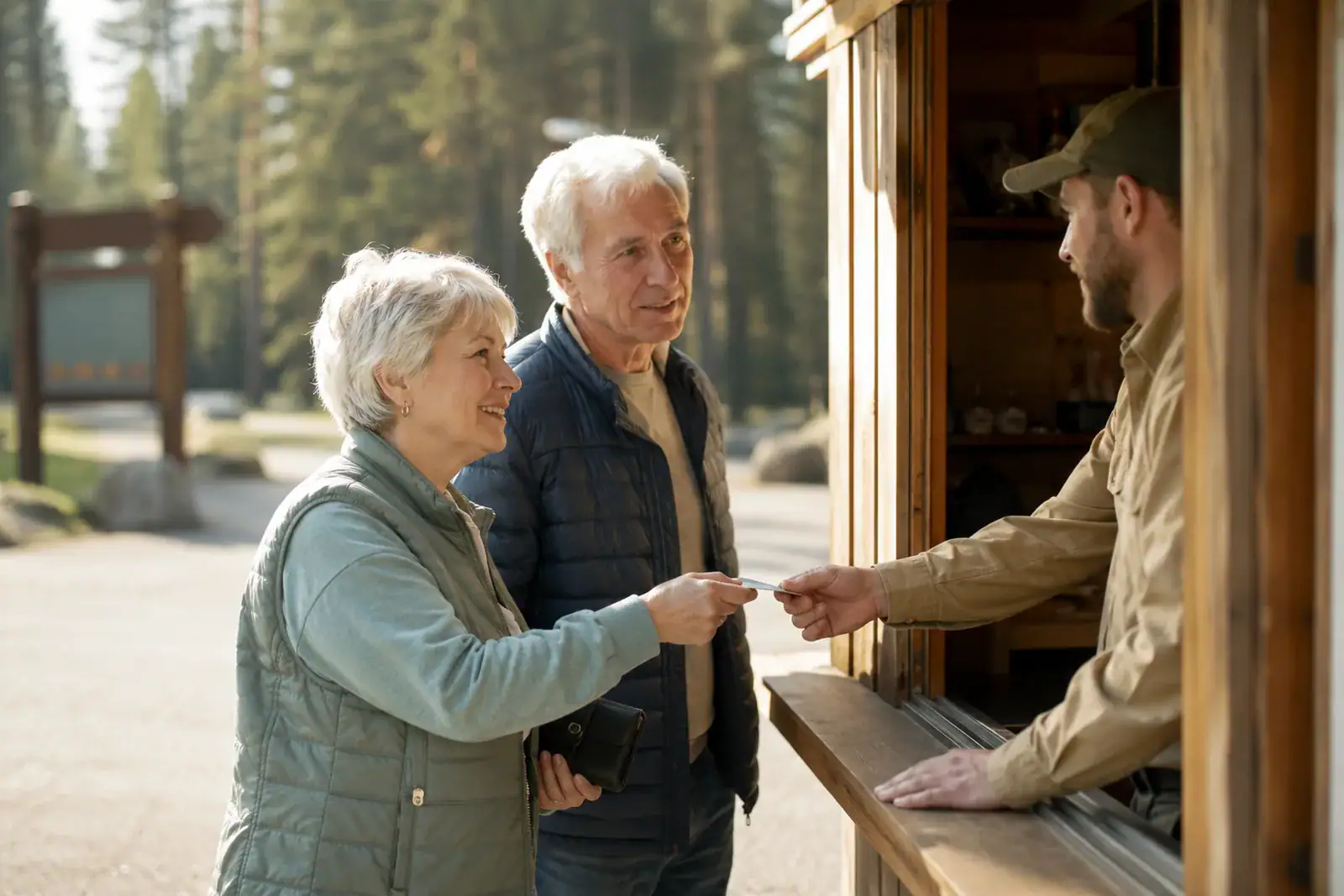
The federal pass does nothing at a state park. Different budget, different statute, different desk.
Almost every state runs its own senior scheme, and the terms move around wildly:
- Some are free or heavily reduced for residents only
- The qualifying age is 60 in some states, 62 or 65 in others
- Some apply midweek or off peak only
- Some want a resident identity card at the gate rather than a pass
There is no national shortcut. Check the park system for the state you are heading into, before you book.
It is fifteen minutes of reading that regularly saves more than the diesel to get there, and it is the least glamorous way to cut campground fees that exists.
5. The Second Vehicle Charge on Your Campground Fees
Plenty of campgrounds bill for a second vehicle on the same site. That is your tow car, or the truck once the trailer is unhitched.
Federal campgrounds often waive or reduce it for pass holders. A fair number of private parks will drop it too if you raise it at check in.
Ask before the card goes through. Once a transaction closes nobody is reversing it, and that line stays in your campground fees for the whole stay.
6. Memberships That Overlap Your Campground Fees
Discount clubs are legitimate and some earn their keep. What matters is that they stack badly against the senior rate rather than adding to it.
Most parks apply one discount, not two. So the club and the pass compete instead of combining.
If you already hold the Senior Pass, run the arithmetic before you renew a membership. On federal ground the pass usually wins. On private parks the club usually wins.
Paying for both and receiving one is the quiet mistake, and it inflates your annual campground fees while feeling like thrift.
7. Dump Station and Water Campground Fees
Many federal and state campgrounds fold dump station and potable water access into the site fee. Standalone stations regularly charge 10 to 20 dollars.
Before paying at a standalone station, check whether the park you are already booked into includes it. It frequently does and it is rarely advertised.
This is the same habit as weighing a propane tank before swapping it, which I cover in our guide to the RV propane refill.
8. The Weekly Rate Buried in Campground Fees
Most campgrounds hold a weekly rate and a monthly rate. The step down from nightly to weekly is often steep and it is almost never volunteered.
If you are staying five or six nights, ask outright what the weekly rate is.
More often than you would credit, the seven night price is lower than the six night price. Nobody at the desk is going to point that out for you.
The same applies to shoulder season. Ask what the rate becomes the week after Labour Day, because plenty of parks drop it quietly and never update the sign out front.
Ask the question at every park and you will shave real money off a season of campground fees without changing a single plan.
9. The Golden Age Passport Sitting in a Drawer
This one is for anyone who has been doing this a long time. Golden Age and Golden Access Passports are no longer sold, but they are still honoured.
Better still, the Park Service will exchange an old Golden Age Passport for a current Senior Lifetime Pass free of charge.
Bring the old pass and photo identification to any site that issues passes. There is no fee and no age reassessment.
Every applicant has to show documentation of age and residency or citizenship. A driving licence covers both for most of us. Passes cannot be bought as gifts, because the recipient must prove eligibility.
If a parent or spouse left one behind, note that passes are not transferable and every holder must show valid photo identification. The exchange only works for the person named.
Campground Fees Compared: Federal and State
| Federal sites | State parks | |
|---|---|---|
| Which pass applies | America the Beautiful Senior Pass | That state’s own senior scheme |
| Qualifying age | 62 | 60, 62 or 65 depending on state |
| Cost | 20 dollars a year or 80 for life | Free to modest, varies widely |
| Typical camping effect | May take 50 percent off some sites | Varies, often residents only |
| Entrance fees | Covered | Not applicable in most states |
| Concession run sites | No discount | Rare, but check |
| Where to confirm | Recreation.gov or any staffed site | That state’s park system directly |
The 62-20-80 Rule for Campground Fees
If you keep one thing from this, keep three numbers.
62 is the age you qualify. 20 dollars is the annual pass. 80 dollars is the lifetime pass, and it clears its own cost in roughly four discounted nights.
62, 20, 80. Say it once at a visitor centre and you will never pay full campground fees on federal ground again by accident.
Where to Spend What You Save on Campground Fees
Campground fees are one line in a much larger budget. Start with our guide to the best travel deals for seniors over 60 and the discounts most seniors miss.
For trips that mix driving with flying or cruising, our guide to the best travel insurance for seniors covers what actually pays out when a trip goes wrong.
If your route runs through the parks, the national park pass guide goes deeper on entrance fees than I have room for here.
Get Our Free Senior Travel Checklist
Our free guides gather the checks worth doing before any trip, whether you are boarding a plane or hitching a trailer. Browse the free guides.
Related Reading on RV and Senior Travel
- 9 Stunning RV Propane Refill Tips for 2026
- National Park Pass for Seniors: The Easy 2026 Money Saver
- 10 Surprising Discounts for Seniors
- Best Travel Deals for Seniors Over 60
- Seniors With Limited Mobility: Travel Guide 2026
- Solo Travel for Seniors: 12 Tips
Frequently Asked Questions About Campground Fees
What age qualifies for senior campground fees discounts?
62. The America the Beautiful Senior Pass is available to United States citizens and permanent residents aged 62 and over, not 65.
How much does the America the Beautiful Senior Pass cost?
20 dollars for an annual pass or 80 dollars for a lifetime pass. Both require documentation of age and residency or citizenship.
Does the Senior Pass cut campground fees in half?
It may provide a 50 percent discount on some amenity fees including camping. It is not guaranteed at every site, and it excludes concessioner charges.
Does the federal Senior Pass work at state parks?
No. State parks run entirely separate senior schemes with their own ages, residency rules and discounts. Check that state’s park system directly.
Why did my pass not reduce my campground fees?
The campground was probably concession operated. The Senior Pass generally does not cover or reduce fees charged by concessioners or special recreation permits.
Can I still use an old Golden Age Passport?
Yes. Golden Age and Golden Access Passports are no longer sold but are still honoured, and can be exchanged free for a current Senior Lifetime Pass.
Is the America the Beautiful Senior Pass transferable?
No. Passes are non-refundable, non-transferable, cannot be replaced if lost, and every holder must show valid photo identification.
When does the lifetime pass pay for itself?
In roughly four discounted nights, plus any entrance fees it covers along the way. The annual pass clears its cost faster still.
Sources
- National Park Service, Entrance Passes and Senior Passes
- Recreation.gov, Senior Lifetime Pass terms
- Recreation.gov, Senior Annual Pass terms
Checked against the sources above on the date of writing. Pass prices, discounts and state programmes change, discounts vary by site and are not guaranteed, and concession operated campgrounds are excluded. General information, not legal or financial advice.