
Table of Contents
I have been buying RV propane the lazy way for years. Pull the empty tank off the A-frame, drive to the cage outside the supermarket, swap it, done in four minutes.
Then I actually read the label. An RV propane refill and an exchange are not the same transaction, and the gap is bigger than I expected.
Most propane guides are written for someone with a backyard grill. This one is written for us.
The Short Answer on RV Propane Refill vs Exchange
An RV propane refill is cheaper almost every time. Exchange cages put about 15 pounds into a cylinder rated for 20, then charge full price.
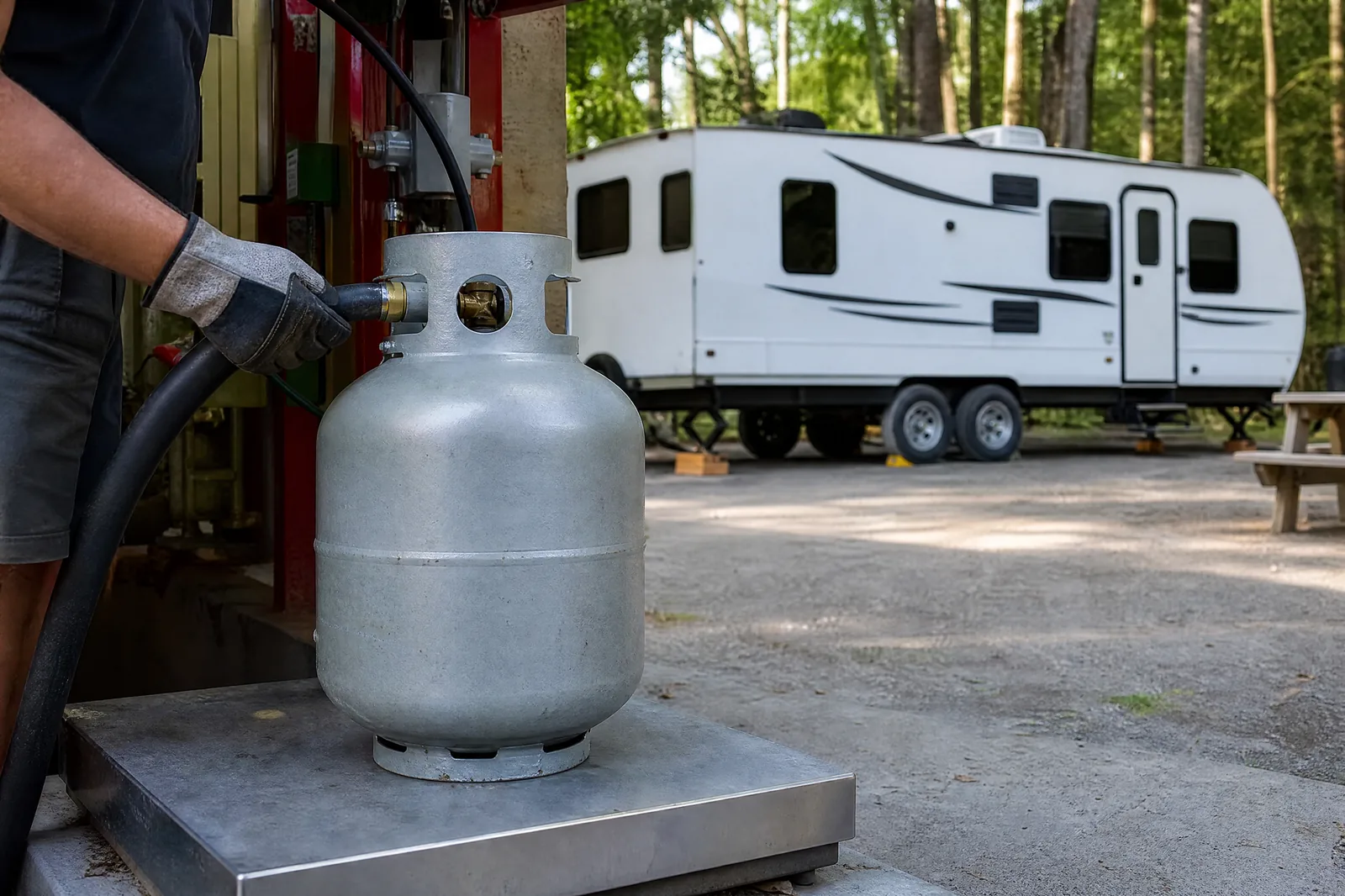
Refill stations fill by weight on a scale, so you pay for what actually enters your tank. Swap only when your cylinder is dead or it is Sunday night.
Key Takeaways on RV Propane Refill Savings
- Exchange cages supply about 15 pounds in a 20 pound cylinder. It is on the label and nobody reads it.
- You get no credit for gas left in the tank you hand over.
- A swap trades your cylinder away. You inherit a stranger’s collar date.
- Motorhomes cannot use cages at all. An RV propane refill is the only option.
- No OPD valve, no refill. Look for the triangular handwheel.
- A cylinder lasts 12 years, then 5, 10 or 12 more after requalification.
- A full tank weighs about 37 pounds, and the cage asks you to carry it twice.
1. The RV Propane Refill Number Printed on the Cage
The grey cylinder on a travel trailer A-frame is a 20 pound tank. No cylinder gets filled to the brim, because liquid propane expands with heat.
Eighty percent of the vessel is the safe ceiling. Twenty pounds is what that ceiling works out to.
Now read the door of an exchange cage. Most sell fifteen pounds. That gap has nothing to do with safety.
Eighty percent would be twenty. Fifteen is a business decision sitting on top of the safety limit, and it is disclosed under net weight labelling rules.
An RV propane refill works the other way round. They set your tank on a calibrated scale and charge for what went in.
2. The RV Propane You Give Away on a Half Full Tank
Picture the Thursday before a trip. The tank has sat on the rig since spring and you have no idea what is in it.
So you pull it and swap it. Sensible. And whatever was still inside is now somebody else’s propane.
There is no credit. A tank with four pounds left and a tank scraped dry are worth the same at that door, which is nothing.
Four pounds is not nothing to me. That is two weeks of coffee and a few cold mornings sorted.
Before any RV propane refill decision, weigh the tank and subtract the tare weight stamped on the collar. Most people find they were swapping tanks a third full.
It is the same habit as weighing a suitcase before the airport, which I cover in our packing and luggage tips.
3. An RV Propane Swap Trades Your Cylinder Too
This is the part I got wrong for years. The transaction feels like a purchase and it is not.
When you swap, your tank goes into the cage and somebody else’s comes out. Fine, until your tank was the good one.
Say you bought a new cylinder two seasons ago. Clean collar, fresh date, no rust. You hand that over and take whatever the driver loaded.
It will be legal. Exchange cylinders are inspected before refilling and unsafe ones are pulled. Legal and equivalent are not the same word.
Own a tank you like? Keep it. An RV propane refill leaves it yours for its whole service life.
4. Motorhomes Need an RV Propane Refill, Not a Cage
Removable cylinders live on travel trailers and fifth wheels, usually two bolted under a cover. Those come off and those can be swapped.
A motorhome is different. The tank is an ASME cylinder mounted to the frame and plumbed into the coach. It never comes off.
So the cage was never an option for you. An RV propane refill is your only route, which matters on a quiet Sunday evening.
The upside is real. A mounted tank holds more, and you always pay for what goes in.
5. The Valve That Blocks Any RV Propane Refill
Turn your tank round and look at the handwheel. A triangle means you are fine. A round wheel with five points is a warning.
The triangle marks an overfill prevention device, or OPD. A float inside shuts the fill off at the safe level.
Cylinders between four and forty pounds have needed one for over two decades. That comes from NFPA 58, which nearly every state wrote into law.
A counter will refuse an RV propane refill without it. They are not being awkward. They would be breaking the rule to fill it.
Used rigs arrive with whatever tanks the last owner left. The rig looks fine, the tank looks fine, and it gets refused anyway.
Check both handwheels this week, not at a counter on Friday. It is the RV version of checking your REAL ID status before the airport.
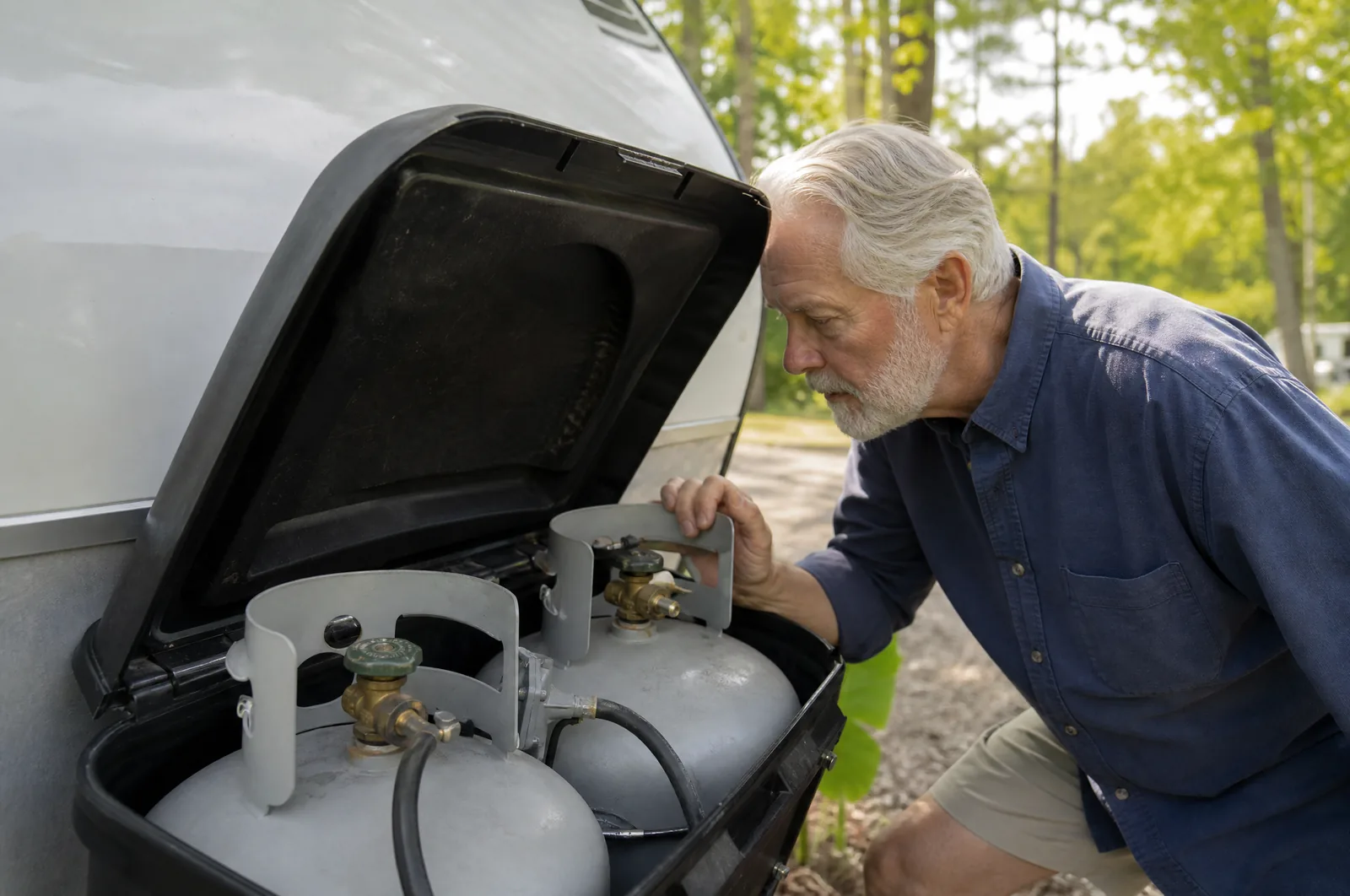
6. The Collar Date Behind Every RV Propane Refill
Run your thumb around the collar, the ring guarding the valve. There is a stamp showing a month and a year.
That is the manufacture date, and it starts a clock. A portable DOT cylinder is good for twelve years from it.
After that, no RV propane refill happens until the tank is requalified by somebody licensed. How long that buys depends on the method.
| Requalification method | Extra life | Collar stamp |
|---|---|---|
| Visual inspection | 5 years | E |
| Proof pressure test | 10 years | S |
| Volumetric expansion test | 12 years | no letter |
Twelve years sounds generous until you subtract on a tank inherited with a used rig.
Every swap takes on somebody else’s clock. Do it a few times and you hold a tank close to done without knowing.
7. What a Full Tank Weighs Before an RV Propane Refill
This gets left out of every version of this conversation, and it matters most as we get older.
A full 20 pound cylinder does not weigh 20 pounds. Twenty is the gas. The steel adds another seventeen or eighteen.
So you are lifting about 37 pounds, awkwardly, one handed, out of a locker at knee height behind a lid you must hold open.
At fifty that is a nuisance. At seventy it is why a lot of us put propane off until the tank runs dry.
Notice what the cage asks. Carry it to the door, wait, carry a full one back. The heaviest version, done twice.
An RV propane refill asks less. On a motorhome you lift nothing at all. If lifting worries you, read our limited mobility travel guide.
8. Where RV Propane Refill Stations Actually Are
The honest objection is that cages are everywhere and fill counters feel extinct. That is exactly why the cage wins by default.
They are not extinct. They are just not where you are looking.
- Farm and ranch supply stores. One on the edge of most towns you drive through.
- Truck and trailer rental yards. Very common, rarely busy.
- Small town hardware co-ops. Often the cheapest counter in the county.
- Propane dealers. The people who fill home tanks will happily fill yours.
- Campgrounds and RV parks. The one everybody forgets, and larger parks bring a truck to your site.
One question sorts it. Ask “do you fill cylinders, or only exchange them?” The word fill separates an RV propane refill from the cage.
If your route runs through national parks, the senior National Park Pass halves campground fees at many sites that also have fill stations.
9. When to Skip the RV Propane Refill and Swap
Nine straight sections of never swap again would be worth distrusting. So here is where the cage genuinely wins.
Your tank has a bad valve, a star handwheel, or an expired collar date. Nobody will fill it and replacing it costs real money.
Walk it to a cage and it is gone. What comes back is a tank somebody will fill. Cheapest exit from a dead cylinder there is.
The second case is simpler. Sunday evening, everything shut, cage lit up. Fifteen pounds you can cook on beats twenty you cannot get until Tuesday.
Nobody should feel clever paying more for less. Nobody should feel foolish buying their way out of a cold morning either.
RV Propane Refill vs Exchange Compared
| Exchange cage | RV propane refill | |
|---|---|---|
| Propane received | Fixed, about 15 lb | What your tank holds, about 20 lb |
| Credit for leftover gas | None | You keep your own tank |
| Your cylinder | Traded away | Stays yours |
| Collar date | A stranger’s | Your own, known |
| Works on a motorhome | No | Yes |
| Availability | Everywhere, long hours | Fewer sites, business hours |
| Best for | Dead cylinders, emergencies | Everything else |
The 20-15-4 Rule for Every RV Propane Refill
If you remember one thing here, make it three numbers.
Twenty is what your tank holds. Fifteen is what a cage puts in it. Four is how many swaps before the shortfall equals a whole tank.
Twenty, fifteen, four. Say it once at the cage and you will never swap on autopilot again.
Gear That Makes an RV Propane Refill Easier
As an Amazon Associate I earn from qualifying purchases. These links cost you nothing extra and help keep these guides free.
- Propane tank gauge. Sits between tank and regulator so you can see what is left: check the price
- Digital hanging scale. Weigh the tank, subtract the tare, and you know your gas: check the price
- Gas leak detector. Finds the source fast, which matters more on a rig than at home: check the price
Cost and Insurance Resources for RV Travel
Propane is one line in a bigger budget. Start with our best travel deals for seniors over 60 and the discounts most seniors miss.
For trips mixing driving with flying or cruising, our best travel insurance for seniors guide covers what actually pays out.
Get Our Free Senior Travel Checklist
Our free guides collect the checks worth doing before any trip, whether you are boarding a plane or hitching a trailer. Browse the free guides.
Related Reading on RV and Senior Travel
- National Park Pass for Seniors: The Easy 2026 Money Saver
- 10 Surprising Discounts for Seniors
- Best Travel Deals for Seniors Over 60
- Seniors With Limited Mobility: Travel Guide 2026
- 12 Essential Packing and Luggage Tips
- Solo Travel for Seniors: 12 Tips
Frequently Asked Questions About RV Propane Refill
How much propane is actually in an exchange tank?
Most exchange programmes fill to 15 pounds in a cylinder rated for 20. The net weight is printed on the cylinder, so read it rather than assuming.
Is an RV propane refill cheaper than an exchange?
Almost always, because you pay per pound that enters your tank. The exception is a dead or expired cylinder, where the exchange is cheaper.
How do I know how much propane is left in my RV tank?
Weigh it. Subtract the tare weight stamped on the collar from the total weight. The difference is your propane. A hanging scale beats a gauge.
What is an OPD valve and how do I spot one?
An overfill prevention device stops the fill at the safe level. A triangular handwheel means OPD. A round or star wheel is the older type.
How long is an RV propane tank good for?
Twelve years from the manufacture date on the collar. Requalification then adds 5, 10 or 12 years depending on the inspection method used.
Can you refill a motorhome propane tank?
Yes, and it is the only option. Motorhome tanks are frame mounted, so they are filled in place at a dealer, a campground, or by a truck.
Do campgrounds do RV propane refill on site?
Many do, and it is the most overlooked option. Ask at check in rather than at the end of your stay, because larger parks send a truck.
Does propane expire in an RV tank?
The propane does not. The steel cylinder does. It carries a twelve year qualification from its stamped date before any RV propane refill is allowed again.
Sources
- PHMSA, Is Your Cylinder Safe to Fill, US Department of Transportation
- 49 CFR 180.209, requalification of specification cylinders
- National Park Service, America the Beautiful Senior Pass terms
- NFPA 58, Liquefied Petroleum Gas Code, overfill prevention requirements
Checked against the sources above on the date of writing. Prices and availability change, requalification depends on the method used, and fill availability varies by town. General information, not legal or financial advice.