Table of Contents
Updated July 2026 · Checked against TSA.gov and DHS.gov · By the Passport Pro Travel team, trusted by 100,000+ senior travelers
Short answer: Yes, you can still fly domestically without a REAL ID — as long as you carry another ID the TSA accepts. A U.S. passport or passport card works everywhere, no star required. Enforcement began May 7, 2025, and starting February 1, 2026, travelers who show up with no accepted ID can pay a $45 fee to use TSA’s new ConfirmID identity check (with delays, and it isn’t guaranteed). The star on a driver’s license is one accepted ID — not the only one.
You booked the trip months ago. The bag is packed, the boarding pass is on your phone, and then a neighbor mentions that your driver’s license “won’t work anymore” at the airport. That one comment can turn a happy week into a sleepless one.
Most people believe the same thing your neighbor does: no REAL ID, no flight. It sounds official, and it’s repeated everywhere. But it’s only half true. The TSA has never accepted only the star-marked license — it accepts a whole list of IDs, and several of them are ones seniors already carry. What actually changed is what happens if you have none of them.
TSA’s own numbers back this up: more than 94% of travelers already pass through with an accepted ID. The rules aren’t there to strand you. They’re there to standardize which documents count. Here’s how it usually goes, what the 2026 changes really mean for you, and the one simple move that takes the whole question off your plate.
Can You Fly Without a REAL ID? The Honest Answer
Yes — you can fly without a REAL ID, provided you bring a different ID from the TSA’s accepted list. This is the part that gets lost in the noise: it’s not about having a REAL ID — it’s about having an accepted ID. The star-marked license is simply the easiest one for people who already have it. If you don’t, a passport does the exact same job at the checkpoint.
Since May 7, 2025, a standard state driver’s license without the star is no longer accepted on its own to board a domestic flight, according to the TSA’s identification page. That’s the change that made headlines. What the headlines skipped is that the accepted-alternatives list didn’t shrink — a passport, a passport card, and several other documents still get you straight through.
What the TSA Accepts Instead of a REAL ID
You only need one ID from this list — not a REAL ID and a passport, just one accepted document. These are the alternatives the TSA lists on its official identification page:
- U.S. passport or U.S. passport card
- DHS trusted traveler card (Global Entry, NEXUS, SENTRI, FAST)
- U.S. military ID (active duty or retired)
- Permanent resident card (green card)
- Enhanced Driver’s License (EDL) from Washington, Michigan, Minnesota, New York, or Vermont
- Veteran Health Identification Card (VHIC)
- Tribal-issued photo ID
- Border crossing card
- Foreign government-issued passport
A REAL ID-compliant license shows a star marking in the upper portion of the card — a star in a circle, a bear, or a state-specific symbol, depending on where you live. No star means it’s a standard license, and a standard license alone won’t board you. If you’re not sure whether yours qualifies, look at the top corners before you leave home, not at the airport.
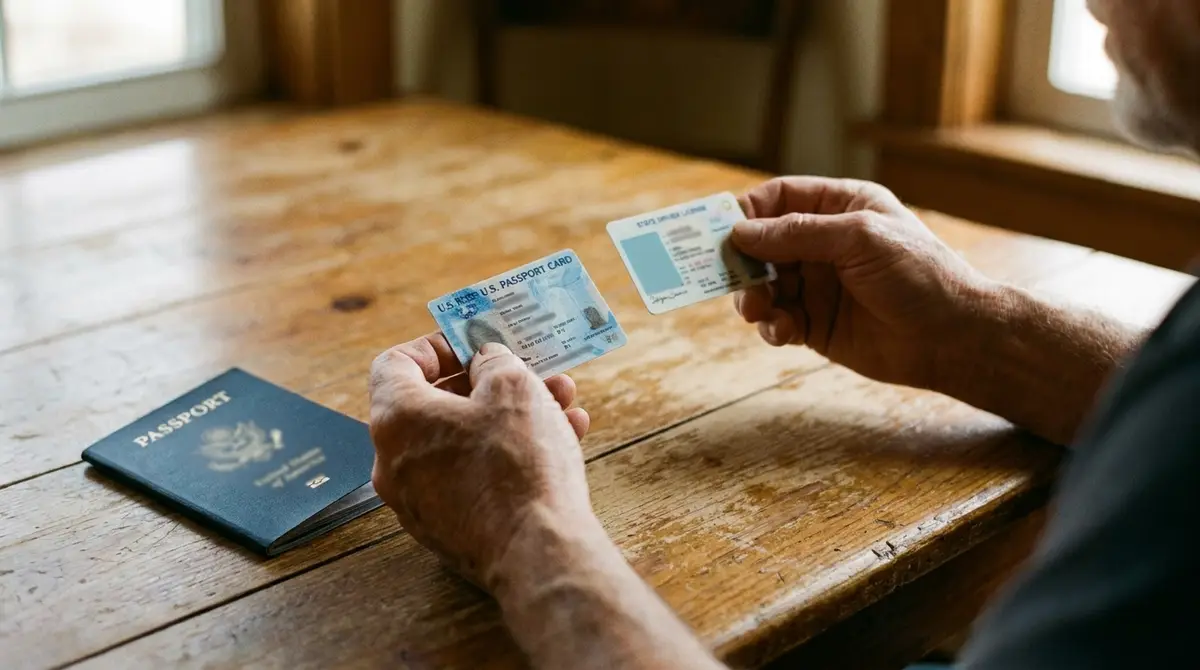
Pro tip: For seniors who don’t drive — or don’t want to renew a license just to fly — the U.S. passport card is the quiet winner. It’s cheaper than a passport book, fits in a wallet, and counts as an accepted ID for every domestic flight. Keep it in an RFID-blocking sleeve so the chip stays protected; the Keep Your Docs collection in our Amazon storefront has a few we trust.
New for 2026: The $45 TSA ConfirmID Fee
This is the piece almost no one has heard about yet, and it’s the biggest change of the year. Starting February 1, 2026, if you arrive at a checkpoint with no accepted ID at all, you’re no longer automatically turned away. The TSA gives you one more option: pay a $45 fee to use TSA ConfirmID, a modernized system that attempts to verify your identity so you can enter the screening line.
A few things worth knowing before you rely on it, straight from the TSA ConfirmID page:
- It costs $45 and is not reimbursable, even if verification fails.
- Verification is not guaranteed. The TSA “attempts” to confirm your identity — it doesn’t promise to.
- Expect delays. The process runs before the security line, so build in extra time.
- You can pay online before you travel or at marked locations at most airports.
Think of ConfirmID as the emergency exit, not the front door. It exists so a forgotten wallet doesn’t automatically cost you the flight — but at $45 a person, with no guarantee and added wait time, it’s the most expensive and stressful way through the checkpoint. It’s essentially a cover charge for forgetting your wallet — and one you can skip entirely by carrying any accepted ID.
REAL ID vs. Passport vs. Passport Card vs. the Fee
| Option | Cost | Works for domestic flights? | Best for |
|---|---|---|---|
| REAL ID license (star) | Standard DMV license fee | Yes | Seniors who still drive and renew anyway |
| U.S. passport book | ~$130 (renewal ~$130) | Yes | Anyone who also travels internationally |
| U.S. passport card | ~$65 (renewal ~$65) | Yes | Non-drivers who only fly domestically |
| TSA ConfirmID fee | $45 per person, per checkpoint | Attempted, not guaranteed | Emergencies only |
The One-Card Rule: The Move That Ends the Worry
Here’s the framework we give every senior traveler who asks about this — call it the One-Card Rule: pick one federally accepted ID, keep it in your travel bag year-round, and never think about the star debate again. For most seniors that card is a passport or passport card, because it never expires from a DMV rule change and it works for cruises and border trips too.
Once that one card lives in your travel pouch, the whole question disappears. You’re not chasing a DMV appointment three weeks before a flight, and you’re not gambling on a $45 fee at the airport. It’s not about having a REAL ID — it’s about having an accepted ID, and the One-Card Rule guarantees you always do. Get the one card, tuck it in the travel bag, and let the whole star-on-the-license debate be somebody else’s airport story.
Expired IDs, Grandkids, and the Questions Seniors Actually Ask
Expired passport or ID? The TSA currently accepts an expired ID for up to two years past its expiration date, for the accepted forms listed above. That buys breathing room — but renew before a big trip rather than betting on an officer’s read of the date. Our US passport renewal guide walks through the form, the photo rules and the timing, including what to do when your trip is only weeks away.
Traveling with grandchildren? The TSA does not require children under 18 to show ID for domestic flights. The adult still needs an accepted ID; the kids don’t. For any unaccompanied-minor questions, the airline sets its own rules, so call them.
What about digital IDs on your phone? The TSA is testing digital options like Apple Digital ID, Clear ID, and Google ID pass at select airports. They’re promising, but they aren’t a nationwide replacement yet — so a physical accepted ID is still the reliable choice. It’s not about having a REAL ID — it’s about having an accepted ID, in a form the checkpoint in front of you can actually take.
Pro tip: Turning 75 or older? Your screening got easier, not harder — you can usually keep your shoes and light jacket on. We broke down exactly what changes in our guide to TSA rules for seniors over 75, so pair it with your One-Card Rule and the checkpoint stops being something to dread.
While you’re organizing documents: your ID gets you through security — it doesn’t protect the trip itself. Our guide to travel insurance for seniors in 2026 covers what happens when flights cancel, bags vanish, or health surprises strike mid-trip.
Three REAL ID Myths That Trip Seniors Up
Myth 1: There’s a senior exemption. There isn’t. Whether you’re 65 or 95, the ID rules are the same — an accepted ID or the ConfirmID option. Age doesn’t waive the requirement.
Myth 2: A Medicare or Social Security card counts. It doesn’t. Those prove benefits, not identity for air travel — they have no photo and the TSA won’t accept them at the checkpoint.
Myth 3: A photo of your license on your phone is fine. It isn’t. Outside the specific digital-ID pilots above, a picture of a document is not a document. Bring the real card.
The takeaway: You can absolutely fly without a REAL ID — just bring one document the TSA accepts, and a U.S. passport or passport card is the simplest. Enforcement has been live since May 7, 2025, and the new $45 ConfirmID fee (February 1, 2026) is a costly backup, not a plan. Follow the One-Card Rule, keep one accepted ID in your travel bag, and the checkpoint question is settled for good.

From the Passport Pro team
Want the complete flying system, not just one article?
The Confident Flyer’s Playbook: TSA walkthrough, senior-discount directory, packing systems and checkpoint scripts — built for travelers over 60.
See what’s inside — $27Frequently Asked Questions
Can you fly without a REAL ID in 2026?
Yes. You can fly domestically without a REAL ID as long as you carry another TSA-accepted ID, such as a U.S. passport or passport card. If you have no accepted ID, you can pay a $45 TSA ConfirmID fee starting February 1, 2026, though verification isn’t guaranteed.
Is there a REAL ID exemption for seniors?
No. There is no age-based exemption. Every traveler 18 and older needs a REAL ID or another accepted form of identification to board a domestic flight.
Does a passport work instead of a REAL ID?
Yes. A valid U.S. passport or passport card is a TSA-accepted ID for domestic flights, with no star or REAL ID needed. It also covers international travel and many cruises.
What happens if I get to the airport without an accepted ID?
Starting February 1, 2026, the TSA will offer an optional $45 ConfirmID identity check. You can pay online beforehand or at marked airport locations. Expect delays, and know that identity verification is not guaranteed.
Can I fly with an expired ID?
The TSA currently accepts an expired ID up to two years past its expiration date for the accepted forms of identification. Renew before a major trip rather than relying on this.
Do my grandchildren need a REAL ID to fly?
No. The TSA does not require children under 18 to show identification for domestic flights when traveling with an adult who has an accepted ID. Check with your airline for unaccompanied minors.
Know your rights before you reach the checkpoint.
Our free Senior Flyer’s Rights & Perks Card lays out the IDs, screening rules, and airport perks you’re entitled to — in plain language you can slip in your travel bag.
Disclosure: some links above are affiliate links. If you buy through them, we may earn a small commission at no extra cost to you. We only recommend gear we’d hand our own parents.