Table of Contents
Updated July 2026 · Checked against TSA.gov · By the Passport Pro Travel team, trusted by 100,000+ senior travelers · About us
Some links below are affiliate links. If you buy through them, we may earn a small commission at no extra cost to you. We only point you to gear and services we would hand our own parents.
The short answer: If you are 75 or older, TSA gives you a lighter version of airport security. You can leave your shoes on, and you keep a light jacket on until the body scanner — where light jackets come off (TSA.gov). If the scanner alarms, you may be asked to remove your shoes or take a pat-down, and you can ask to sit down for it. Anyone who cannot stand is screened another way. You can also call TSA Cares at (855) 787-2227 at least 72 hours before your flight for free, personal help. That is the heart of the TSA rules for seniors over 75.
Airport security is the part of the trip most travelers over 75 quietly dread. The belt, the shoes, the arms overhead, the line moving behind you — it can feel like a test you did not study for. The good news: the TSA rules for seniors over 75 are written to make the checkpoint easier, not harder.
Most people assume the rules are the same for everyone: shoes off, jacket off, empty your pockets, and hope for the best. They are not. The Transportation Security Administration (TSA) runs a gentler, faster screening built around passengers 75 and older — and most seniors never find out because no sign at the checkpoint tells you.
We cross-checked every rule below against TSA.gov’s own pages in July 2026, so you are reading the current policy, not a travel blog’s memory of it. Here is the line to keep in your head as you walk up: you have earned the easier line — you just have to claim it.
In the next few minutes you will learn exactly what changes at 75, what to do if the scanner beeps, the free help line almost no one uses, how your medications and mobility aids are handled, and whether TSA PreCheck is worth paying for once you already get expedited screening.
1. At 75, You Keep Your Shoes On
Passengers 75 and older can leave their shoes on at the checkpoint. This is the single biggest change, and it is the answer to the question most seniors ask: do you have to take off your shoes at airport security after 75? For you, the default is no. TSA calls this “expedited screening,” and it applies automatically the day you turn 75 — there is nothing to sign up for and nothing to show (TSA.gov, Screening for Passengers 75 and Older).
One catch to know before you get there: light jackets still come off for the body scanner. TSA’s own rule is that “removal of light jackets is required for Advanced Imaging Technology screening” — that is the machine you stand inside with your arms up. So plan to slip the jacket off, keep the shoes on, and you are moving.
You still send your carry-on, purse, and any loose metal through the X-ray belt like everyone else. If you need the full rundown of what can and can’t go in that carry-on, see my complete guide to TSA carry-on rules for 2026. The gift is your shoes stay on your feet — no balancing on one leg in a security line, no cold floor, no wrestling laces back on at the other end.
2. What Happens If the Scanner Alarms
The body scanner does not know your knee is metal or your pocket has a tissue in it — it just beeps. Here is how this usually goes: the officer sees an alarm, and per TSA policy you “may be required to remove your shoes for further screening or undergo a pat-down.”
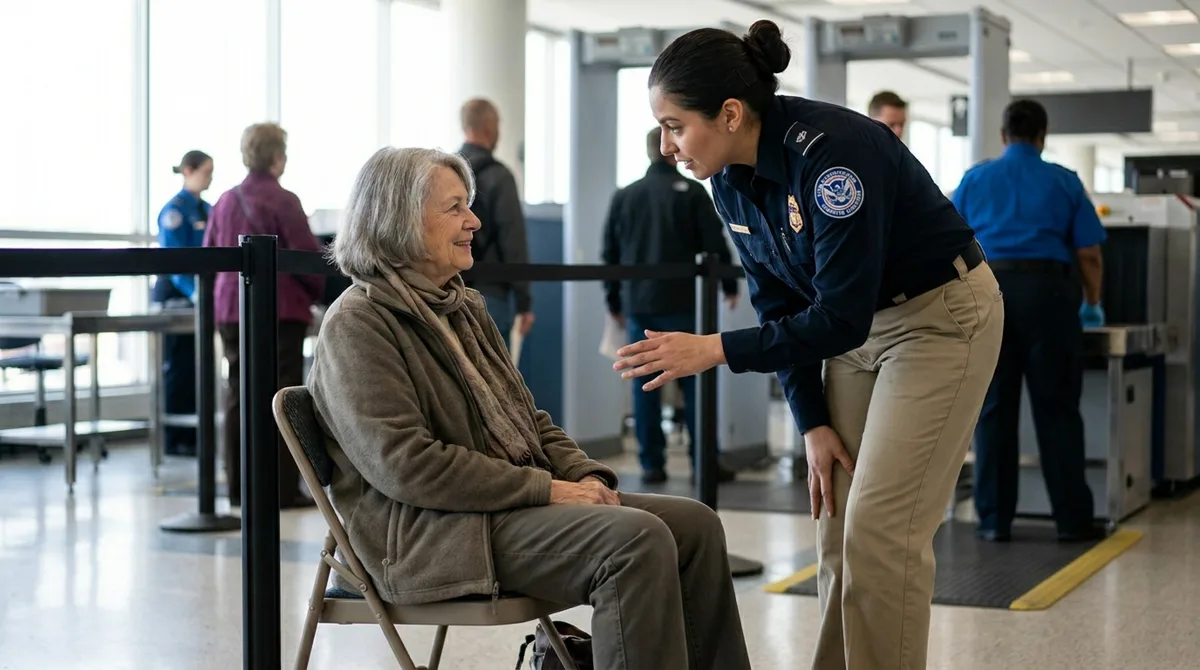
This is the part worth memorizing, because it is the right inside the TSA rules for seniors over 75 that most travelers never use: you can request to be seated during this portion of the screening. You do not have to stand for a pat-down. Ask for a chair, and TSA provides one. Naming that out loud — “I would like to sit for this” — turns a stressful few minutes into a calm one.
A pat-down is done by an officer of the same gender, and you can ask for it to happen in a private room with a travel companion present. None of this counts against you. An alarm at 75 is routine, not a red flag.
Pro tip: If a knee or hip replacement sets off the scanner every single trip, you do not need a doctor’s note — TSA does not require one. But keeping your surgeon’s name and the year handy in your phone makes the conversation faster. And if a long flight follows, a $12 pair of graduated compression socks like these CHARMKING socks keeps swelling down on the plane — slip them on before you leave home, since they stay on right through the checkpoint.
3. Cannot Stand for Screening? You Still Get Cleared
If standing in the scanner is not possible — a wheelchair, a walker, poor balance, a bad day — you are not stuck. The TSA rules for seniors over 75 are plain: “Passengers 75 and older who are unable to stand for screening will be screened through other security methods.” That usually means a seated pat-down and a hand inspection instead of the machine.
Your mobility equipment travels with you through the checkpoint. Walkers, canes, crutches, and wheelchairs are either X-rayed or inspected by hand — you are never asked to give them up or separate from them in a way that leaves you unsupported. If a device cannot fit through the X-ray, the officer inspects it right there with you.
You are doing great — let’s keep this simple. The system is built so that not being able to stand never becomes the reason you miss a flight.
4. TSA Cares: The Free Help Line Almost No One Uses
This is the insider move, and it costs nothing. TSA runs a help line called TSA Cares for older travelers and anyone with a medical condition or disability. Call it before you fly and TSA will walk you through exactly what your screening will look like — and, at many airports, arrange for someone to meet you. It is the most underused piece of the TSA rules for seniors over 75.
Call the 72-Hour Call: dial (855) 787-2227 at least 72 hours before your flight (TSA.gov). Tell them your date, your airport, and anything that affects your screening — a pacemaker, an ostomy, oxygen, trouble standing, memory concerns. They can assign a Passenger Support Specialist, a TSA officer trained to guide you through security in person and answer questions at the checkpoint.
Pro tip: Print the free TSA Notification Card (a one-page PDF from TSA) and hand it to the officer instead of explaining a medical condition out loud in a crowded line. Want the whole set of senior-flyer rights on one page — discounts, screening, and refunds you are owed? Our free Senior Flyer’s Rights & Perks Card puts them in your wallet.
5. Medications, Medical Devices, and Liquids
Medications get the friendliest rules at the whole checkpoint, and they apply at every age. Pills, and medically necessary liquids, gels, and creams, are exempt from the usual 3.4-ounce limit — you can bring more than a travel-size amount. You just have to declare them to the officer before screening starts and keep them separate from the rest of your bag (TSA.gov, What Can I Bring).
That exemption also covers ice packs, freezer packs, IV bags, pumps, and syringes that keep a medication cold or usable. TSA may test these for explosives or open a container, and if you would rather your pills not go through the X-ray, you can ask the officer to inspect them by hand instead.
For everything else in your quart bag, the regular 3-1-1 rule still holds. If you want the full breakdown of what fits and what gets tossed, we wrote a plain-English guide to the TSA liquid rules and the exact mistakes that get medications flagged in our TSA medication guide.
6. Is TSA PreCheck Worth It for Seniors Over 75?
Here is where many travelers slip up: they assume that because they already keep their shoes on at 75, TSA PreCheck would be a waste of money. It is a fair question — and the answer depends on how much of the checkpoint you want to skip. PreCheck does not replace the TSA rules for seniors over 75 — it stacks on top of them.
TSA PreCheck costs $78 for five years (TSA.gov) and gets you a shorter, dedicated line where you keep on your shoes, belt, and light jacket and leave your laptop and your 3-1-1 liquids inside your bag. Being 75 gets you the shoes; PreCheck gets you the belt, the light jacket through the scanner, and no unpacking. Over five years, $78 works out to about $16 a year — roughly the price of two airport coffees — for a faster line every single trip.
If you fly two or more round trips a year, PreCheck usually pays for itself in saved stress alone. If you fly once every few years, the free 75-and-older screening may be all you need. Here is how the three lines compare:
| At the checkpoint | Standard adult | Age 75+ (free) | TSA PreCheck ($78/5 yr) |
|---|---|---|---|
| Shoes | Take off | Keep on | Keep on |
| Light jacket | Take off | Off for scanner | Keep on |
| Belt | Take off | Off if it alarms | Keep on |
| Laptop out of bag | Yes | Yes | No, leave it in |
| 3-1-1 liquids out | Yes | Yes | No, leave them in |
| Who qualifies | Everyone | Age 75+, automatic | Apply + background check |
| Cost | Free | Free | $78 for 5 years |
Pro tip: If you decide PreCheck is worth it, apply at least a few weeks before a big trip — approval is usually quick but not instant. And while you are getting travel-ready, our free senior travel guides and the gear we actually recommend on our Amazon storefront cover the small comforts that make a long day of flying easier.
TSA Rules for Seniors Over 75: Your 4-Step Plan Before You Leave Home
- Pack medications in one clear bag you can lift out and declare — separate from everything else.
- Wear slip-friendly shoes anyway. You keep them on at 75, but easy shoes help if the scanner sends you for a second look.
- Call TSA Cares at (855) 787-2227 72 hours out if anything about your health or mobility worries you.
- Decide on PreCheck if you fly more than once a year — the $78 buys five years of the fastest line.
Do those four things and the checkpoint stops being the scary part of the trip. Remember the line: you have earned the easier line — you just have to claim it. While you are planning, it is also worth checking the airline senior discounts you may be owed on the ticket itself.
Free: The Senior Flyer’s Rights & Perks Card
One printable page with the screening rights, senior discounts, and refunds most travelers over 60 never claim. Keep it in your wallet for the next trip.

From the Passport Pro team
Want the complete flying system, not just one article?
The Confident Flyer’s Playbook: TSA walkthrough, senior-discount directory, packing systems and checkpoint scripts — built for travelers over 60.
See what’s inside — $27Frequently Asked Questions
What are the TSA rules for seniors over 75 in 2026?
The TSA rules for seniors over 75 give you expedited screening at every US checkpoint: shoes and a light jacket stay on, pat-downs can be taken seated, liquid medications are exempt from the 3.4 oz limit when declared, and TSA Cares at (855) 787-2227 arranges free help if you call 72 hours ahead (TSA.gov).
Do seniors over 75 have to take their shoes off at airport security?
No. TSA gives passengers 75 and older expedited screening, which lets you keep your shoes on at the checkpoint (TSA.gov). The one exception is if the body scanner alarms — then an officer may ask you to remove your shoes for a second look or do a pat-down, which you can take while seated.
Do people over 75 need TSA PreCheck?
You do not need it — the TSA rules for seniors over 75 already let you keep your shoes on for free. But PreCheck adds real convenience: you also keep your belt and light jacket on and leave your laptop and liquids in your bag. If you fly more than once a year, most seniors find the shorter line worth the $78 five-year fee.
How much does TSA PreCheck cost for seniors?
TSA PreCheck costs $78 for a five-year membership, and there is no senior discount — the price is the same at every age (TSA.gov). That works out to about $16 a year. Renewing online later is often a little cheaper than enrolling for the first time.
What is the TSA Cares phone number, and when should I call?
TSA Cares is (855) 787-2227. TSA asks you to call at least 72 hours before your flight so they can review your screening and, at many airports, arrange a Passenger Support Specialist to help you through the checkpoint in person. The help line is free and open to any senior or traveler with a medical condition.
Can I sit down during a TSA pat-down?
Yes. The TSA rules for seniors over 75 let you request to be seated during a pat-down or additional screening. Just tell the officer you would like a chair. You can also ask for the pat-down to be done in a private area with a companion present, at no cost and with no delay to your travel.
The takeaway: At 75, airport security bends toward you — if you know what to claim.
- You keep your shoes on; only light jackets come off for the scanner.
- If the scanner alarms, you can ask to sit for the pat-down.
- Cannot stand? You are cleared by other methods — you never lose your walker or cane.
- Call TSA Cares (855) 787-2227, 72 hours ahead, for free personal help.
- Medications beat the 3.4-oz limit — just declare them.
- PreCheck ($78/5 yr) is worth it if you fly more than once a year.
The TSA rules for seniors over 75 earned you the easier line — you just have to claim it.
Keep planning your trip: Airline senior discounts you may be owed · TSA medication mistakes to avoid · Free senior travel guides · watch more at Passport Pro on YouTube.