Table of Contents
Updated July 2026 · Checked against TSA.gov and major U.S. airline baggage policies · By the Passport Pro Travel team, trusted by 100,000+ senior travelers
Short answer: Most luggage disasters come from a few avoidable habits — packing valuables or medication in a checked bag, using a plain look-alike suitcase with no tracker, and going over the 62-inch size limit that triggers a fee. The fixes are cheap and take minutes: keep anything you can’t replace in your carry-on, make your bag easy for you to spot but boring to a thief, drop a tracker inside, and measure before you leave. Do those four and you’ve dodged the mistakes that strand most travelers.
You watch the baggage carousel go around one more time. Everyone else has grabbed their bag and gone. Yours isn’t coming — and the airline’s first question is one you can’t answer: “What does it look like?”
Most travelers think lost or stolen luggage is bad luck. Usually it isn’t. It’s a handful of small decisions made before you ever left the house — the tag you used, the color of the bag, what you packed where. Fix those and the odds swing hard in your favor.
None of this takes special gear or insider access. It’s about making your suitcase do two jobs at once: boring to strangers, obvious to you. Here’s how it usually goes wrong, grouped by what each mistake actually costs you — money, the bag itself, or your peace of mind — with the 2026 fix for each.
Mistakes That Cost You Money
Ignoring the 62-inch size limit. Most U.S. airlines cap a checked bag at 62 linear inches — length plus width plus height, wheels and handles included — and a typical weight limit of 50 pounds. Go over either and you’re looking at oversize or overweight fees that often run $100 to $200 or more each way. Measure your packed bag at home; a tape measure costs nothing and the fee doesn’t.
| Limit | Typical standard | What happens if you exceed it |
|---|---|---|
| Size | 62 linear inches (L + W + H) | Oversize fee, often $100–$200+ each way |
| Weight | 50 lbs (23 kg) in economy | Overweight fee, often $100–$200+ each way |
| Extra bag | 1–2 included varies by fare | Second-bag fee, often $40–$100 |
Checking your bag too early. Arriving early is smart; handing your bag over the moment you arrive is not. The longer it sits in the system, the more chances it has to be mis-routed. Check it closer to your window — roughly 90 minutes out for domestic flights, two to three hours for international — not the instant you walk in the door.
Mistakes That Lose Your Bag
Leaving old flight tags on the handle. Those sticky barcode tags from your last trip can confuse the automated scanners and send your suitcase to the wrong city. Peel every old tag off before you leave home — it takes ten seconds and prevents a genuinely common routing error.
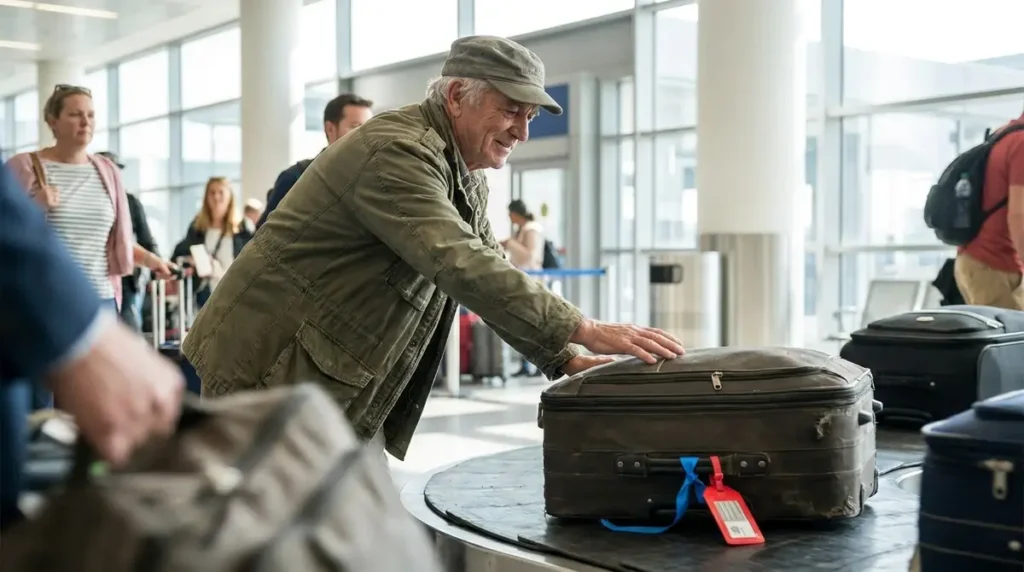
Carrying the same black bag as everyone else. A plain black suitcase blends into a sea of identical bags at the carousel, which invites both honest mix-ups and dishonest grabs. Watching two hundred near-identical black bags roll past is not the moment to discover a hidden talent for spotting subtle differences. Make yours instantly yours: a bright strap, a colorful tag, or a ribbon on the handle. And skip flashy designer luggage — it draws the wrong kind of attention.
Not photographing your bag before you check it. If it goes missing, a clear photo of the outside and a quick shot of what’s inside answers every question the airline will ask. Snap both before you leave, and tuck a card with your name and phone number inside a pocket in case the external tag falls off.
Pro tip: The single best upgrade is a Bluetooth tracker tucked deep inside the bag — an Apple AirTag or Samsung SmartTag lets you watch your suitcase move in real time, even when the airline can’t. Pair it with a bright, hard-to-mistake luggage tag; you’ll find both in the travel-gear picks in our Amazon storefront. Hide the tracker under the lining so it isn’t obvious to anyone else.
Mistakes That Invite Theft
Putting your home address on the tag. A visible home address tells a stranger exactly which house is empty while you’re away. Use your cell number and email instead — or a work or hotel address — and choose a flap-style tag that hides the details until someone lifts the cover.
Flashing “priority” or “high-value” tags. Those labels feel like a perk, but to a dishonest handler they mark your bag as worth grabbing. Unless a tag is medically necessary or part of an official airline program, a plain, unremarkable suitcase is the safer bet.
Tossing your boarding pass and bag-tag stub. That little stub is your proof of ownership if the bag goes missing, and the boarding pass carries your name and frequent-flyer number. Keep both tucked in your passport, and shred them once you’re home rather than dropping them in an airport bin.
Lingering at the carousel. An unclaimed bag going around and around is easy for someone to lift. Head straight to the belt, stand close, and grab yours the moment it appears.
Mistakes That Cost You Comfort and Health
Packing anything irreplaceable in your checked bag. Once it’s checked, it’s out of your hands — bags get delayed, crushed, and occasionally opened. Medications, laptops, jewelry, cameras, documents, and fragile gifts belong in your carry-on. If it’s glass, antique, or essential, it flies with you or it doesn’t fly at all. This one matters most for older travelers: a delayed bag should never mean a missed dose.
Not packing a carry-on “first 24 hours” kit. If your checked bag is late, your carry-on is your lifeline. Pack one change of clothes, basic toiletries, chargers, and all your medication — enough to get through a day or two comfortably if the suitcase doesn’t show.
Setting your suitcase on the hotel bed. Bed bugs hitchhike home in luggage more than most people realize. Keep your bag on the luggage rack, the bathroom tile, or in the tub — never the bed. Back home, run washable clothes through a hot wash and a high-heat dryer of at least 120°F for 30 minutes, which kills bed bugs at every life stage, and wipe down the wheels and handles before you store the bag.
The Findable-but-Forgettable Rule
You don’t need to memorize fifteen separate tips. Use the one framework we give every traveler — the Findable-but-Forgettable Rule. Before any bag leaves the house, ask two questions: Can I spot this instantly at the carousel? (bright tag, tracker inside, old tags removed) and Does it look boring and low-value to a stranger? (no home address, no priority labels, no designer flash). A bag that’s easy for you to find and dull for everyone else is a bag that comes home with you.
Add the carry-on rule on top — nothing irreplaceable ever goes below — and you’ve covered the mistakes that actually cost people their trips. Your suitcase doesn’t need to be handsome; it needs to be the wallflower of the baggage carousel — dull to everyone else, unmistakable to you. Boring to strangers, obvious to you. That’s the whole game.
Pro tip: Not sure what belongs in your carry-on versus the hold? Our free TSA Packing Checklist spells it out line by line — and if you’re weighing what’s even allowed below deck, pair it with our guide to the 2026 TSA checked baggage rules so nothing gets pulled or fined.
The takeaway: Luggage trouble is mostly preventable. Measure your bag against the 62-inch limit, make it findable with a bright tag and a hidden tracker, strip old tags and home addresses, and keep medication, valuables, and a change of clothes in your carry-on. Boring to strangers, obvious to you — that one habit turns baggage claim from a gamble into a formality.

From the Passport Pro team
Want the complete flying system, not just one article?
The Confident Flyer’s Playbook: TSA walkthrough, senior-discount directory, packing systems and checkpoint scripts — built for travelers over 60.
See what’s inside — $27Frequently Asked Questions
How early should I check my bag?
Check it closer to your flight, not the moment you arrive — about 90 minutes before a domestic flight and two to three hours before an international one. The less time your bag sits idle in the system, the less chance it has to be mis-routed.
What is the checked bag size limit?
Most U.S. airlines cap checked bags at 62 linear inches (length + width + height, including wheels and handles) and 50 pounds in economy. Going over either usually triggers an oversize or overweight fee of roughly $100 to $200 or more each way.
Do AirTags and luggage trackers work in checked bags?
Yes. A Bluetooth tracker like an Apple AirTag or Samsung SmartTag lets you follow your suitcase in real time, which is invaluable if the airline loses track of it. Tuck it deep inside the bag so it isn’t easily spotted.
Why should I remove old flight tags?
Old barcode tags can confuse automated sorting scanners and send your bag to the wrong destination. Peel off every previous tag before you head to the airport.
What should I never pack in a checked bag?
Never check medications, laptops, jewelry, cameras, important documents, or anything fragile or irreplaceable. Keep those in your carry-on, where a delay or loss can’t strand you without them.
How do I keep bed bugs out of my luggage?
Keep your suitcase off the hotel bed — use the rack, tile, or tub. At home, wash clothes hot and run them through a dryer at high heat (at least 120°F) for 30 minutes, which kills bed bugs at every life stage, then wipe down the bag before storing it.
Pack smart, lose nothing.
Our free TSA Packing Checklist lays out exactly what belongs in your carry-on versus the hold, plus the pre-flight steps that keep your bag findable and yours — so baggage claim stops being a worry.
Disclosure: some links above are affiliate links. If you buy through them, we may earn a small commission at no extra cost to you. We only recommend gear we’d hand our own parents.